
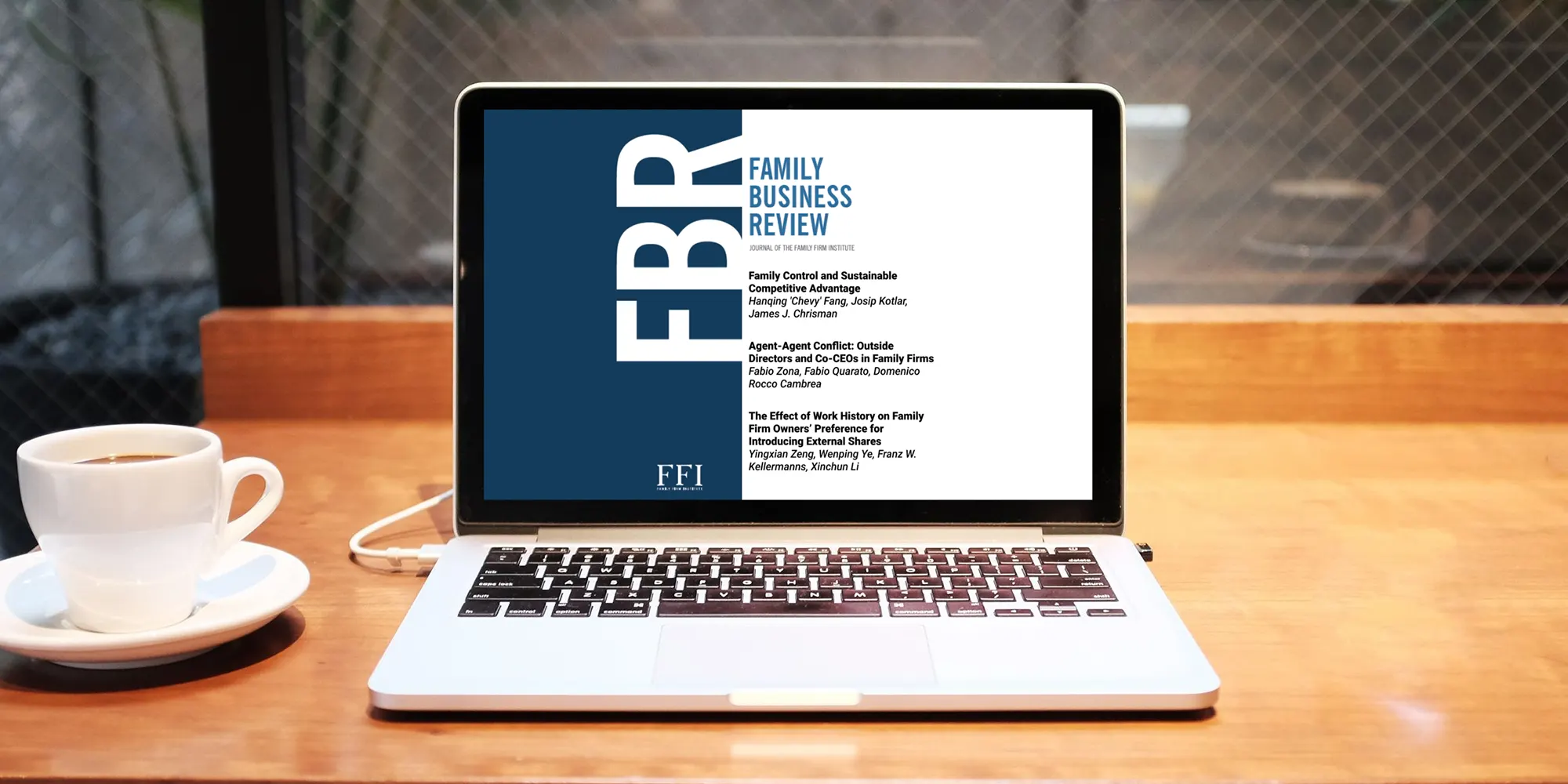

e are pleased to offer you an early look at the June 2025 issue of Family Business Review (FBR).
As an FFI member, you enjoy complimentary access to the entire FBR article library, with more than thirty years insights and research tailored for the family enterprise community.
Accessing FBR and Past Issues is Simple:
- Log in to your FFI member account.
- Visit: my.ffi.org/page/family-business-review.
- Click the link on this page, and you’ll be automatically redirected to FBR for seamless access to the latest issue and the full archives.
About FBR:
Published by SAGE, Family Business Review is a refereed journal renowned for its high academic standards and practical insights. It boasts a two-year impact factor of 9.9 and ranks 11 out of 302 business journals (Source: Journal Citation Report®, Clarivate, 2023).
Hanqing ‘Chevy’ Fang, Josip Kotlar, James J. Chrisman
- How does family control influence the sustainable competitive advantages of high-performing family firms?
- Why are family firms that have obtained competitive advantages better able to sustain their advantages than nonfamily firms?
- What governance and ownership structures enhance or hinder the ability of family firms to sustain competitive advantages?
- Family firms should capitalize on their historical path dependency, social complexity, and resource inseparability to sustain competitive advantages.
- Investing in the education, mentoring, and leadership involvement of future family members strengthens long-term commitment and performance sustainability.
- Family businesses should tailor their competitive strategies based on ownership type, generational leadership, and governance configurations.

Hanqing 'Chevy' Fang

Josip Kotlar

James J. Chrisman
About the Authors
Josip Kotlar, FFI Fellow, is a full professor of strategy, innovation, and family business at Politecnico di Milano. His research explores topics of strategy, governance, innovation and entrepreneurship in family businesses and business families, including the study of family offices.
James J. Chrisman is the Julia Bennett Rouse Professor of Management at Mississippi State University and a senior editor of Entrepreneurship Theory and Practice. His research is in family business, entrepreneurship, and strategic management.
Fabio Zona, Fabio Quarato, Domenico Rocco Cambrea
- Does a co-CEO structure engender an agent-agent conflict to magnify the agency costs and monitoring needs by the board?
- Does monitoring by outside directors on the board make a difference in family firms’ decision outcomes (e.g., firm export) more under co-CEO or under solo-CEO structures?
- Inspecting co-leadership composition, under what co-CEO structures (i.e., all non-family co-CEOs, all family co-CEOs, and mixed co-CEOs) are outside directors more beneficial?
- Is the positive influence of the outside directors under co-CEOs structures magnified in the first founding family generation, or in family generations after the first?
- Challenging the accepted view that co-CEOs reduce agency problems via mutual monitoring, co-leadership entails risks to the firm, when co-CEOs share a common influential, self-serving principal-owner.
- Family firms should increase outside directors on the board, particularly when they adopt co-CEO structures, and do so in family generations after the first.
- Hiring outside non-family CEOs to run the firm jointly with family CEOs (mixed co-leadership) may involve agency costs to family businesses, particularly in family generations after the first.
- Advisors, practitioners, and opinion leaders should not overstate the benefits of co-CEOs, and should rather examine the settings in which co-CEOs may be beneficial or detrimental.

Fabio Zona

Fabio Quarato

Domenico Rocco Cambrea
About the Authors
Fabio Quarato is a tenured lecturer of management and is managing director of the AIDAF-EY Chair in Family Business at Bocconi University. His main research interests are in the field of corporate governance and family firms.
Domenico Rocco Cambrea is associate professor of business administration at the University of Modena and Reggio Emilia. His research is focused on cash reserves and on corporate governance in family and non-family firms.
Yingxian Zeng, Wenping Ye, Franz W. Kellermanns, Xinchun Li
- How does the family firm owner’s early work experience in the public economy affect the family firm’s equity mix?
- Will family ownership and government subsidies affect this relationship?
- Family firm owners should recognize biases originating from early imprinting effects and strive for optimal equity mix.
- Conversely, equity investors should pay attention to preferences in family firms that can affect their successful cooperation with family businesses.
- Higher family ownership and higher government subsidies heightens the negative imprinting effects early career experiences in state-owned company on foreign equity.

Yingxian Zeng

Wenping Ye

Franz W. Kellermanns
WHU–Otto Beisheim School of Management

Xinchun Li
About the Authors
Wenping Ye is a professor in the School of Management at Jinan University, China. His research covers entrepreneurship, family business, and mobility and labor markets.
Franz W. Kellermanns is the Addison H. & Gertrude C. Reese Endowed Chair in International Business and professor of management in the Belk College of Business at the University of North Carolina–Charlotte, USA. He holds a joint appointment with the Center for Family Business at the WHU–Otto Beisheim School of Management, Germany.
Xinchun Li is a professor of strategic management and entrepreneurship and the director of the Chinese Family Business Research Centre at Sun Yat-sen University, China. He was dean of School of Business at Sun Yat-sen University and the founding editor of Quarterly Journal of Management. His research interests focus on strategic alliances, family business, and entrepreneurship.