




The family patriarch smiles politely.
The room goes quiet.
She has, unknowingly, just walked into a dark room and started searching for furniture that may not exist.
The dark room metaphor is instructive for family enterprise advisors operating across cultural contexts. When we enter an unfamiliar household, we instinctively reach for what we know—a chair, a table, a light switch in a familiar place. But in a non-Western family business context, the room may be furnished entirely differently. Assuming otherwise does not merely lead to awkward pauses; it can erode trust, foreclose crucial conversations, and ultimately diminish our effectiveness as advisors.
This article presents a practical, three-step framework for constructing what we call “great questions”—inquiry-based tools that work across cultural contexts to unlock genuine insight, build trust, and invite clients into honest, productive dialogue about the most pressing challenges facing their family enterprise.


Why Most Questions Fall Short
Research on family firm advising shows that advisors who elicit higher-quality client feedback are better able to generate adaptive and innovative advice, suggesting that the quality of an advisor’s questions affects the quality of the insights surfaced (Davis et al. 2013). Yet, in practice, advisors—especially those operating under time pressure or in unfamiliar cultural terrain—tend to default to closed, confirmatory, or leading questions.
We ask questions we already know the answer to. We ask yes-or-no questions that produce binary responses but no narrative. We ask questions that feel safe but rarely generate the honest, story-driven reflection that allows advisors to truly understand a client’s situation.
The cost is real. Issues such as shared ownership conflicts, communication breakdowns across generations, and management and ownership contingency gaps often remain invisible until they become crises, partly because advisors did not ask the right question, of the right person, at the right moment.
The challenge intensifies in cross-cultural contexts. In collectivist cultures, direct questioning about conflict or disagreement may be perceived as confrontational or disrespectful. In high-context communication environments, what is left unsaid carries as much weight as what is spoken—verbally, nonverbally, and paraverbally. Advisors who fail to account for these dynamics will consistently miss the signals that matter most.

The Anatomy of a Great Question
Before presenting the framework, it is worth establishing what distinguishes a genuinely powerful question from a merely competent one.
Effective questions help families recognize an advisor’s preparation, curiosity, and ability to understand the unique governance and relational challenges of family enterprises (Green 2018). A great question has four characteristics:
- It avoids yes-or-no answers; open questions produce narratives, not verdicts.
- It surfaces something the advisor does not already know. Genuine curiosity cannot be faked, and clients sense when it is absent.
- It invites the client into “story mode.” Questions framed around hopes, worries, patterns, and experiences encourage reflection rather than defensiveness.
- It is prepared in advance and organized thematically. Improvised questions tend to be reactive; crafted questions are strategic.
“Is your succession plan documented?”
and
“What are your greatest hopes for your children’s experience of shared ownership?”
The first confirms a fact.
The second opens a world.
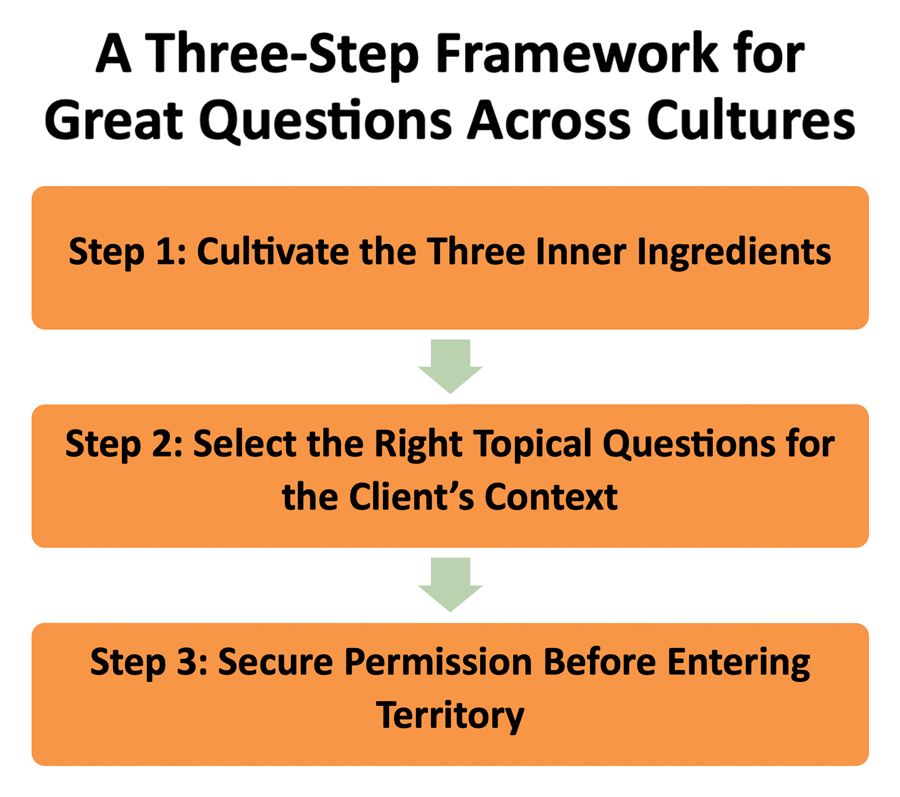
Step 1: Cultivate the Three Inner Ingredients
Powerful questions begin not with technique but with inner orientation.
Before formulating a single question, advisors must enter every client engagement with three foundational qualities:
- Genuine curiosity
- Care for the client’s well-being
- Humility
Care for the client’s well-being means keeping the family’s long-term flourishing—not simply the immediate engagement objective—as the north star of the advisory relationship.
Humility, perhaps the most culturally variable of the three, requires different expressions depending on context. In individualistic cultures, humility may present as intellectual openness. In collectivist cultures, it manifests as relational deference: acknowledging the family’s wisdom and authority before positioning your own expertise.
This distinction becomes especially consequential in group advisory settings, where trust is held collectively rather than individually.
In individualistic cultures, trust is often built person to person; the advisor earns credibility through demonstrated expertise in a dyadic relationship. In collectivist cultures, advisors frequently enter a room of multiple stakeholders, where trust is granted relationally by the group—and only after the family senses alignment between the advisor’s values and its own.
Asking a courageous question before that collective trust is established can easily backfire.
Reading the room—knowing whether you are in a one-on-one conversation or a collective negotiation—is the prerequisite to everything that follows.
These three qualities are not soft skills. They are the conditions that make great questions possible. Without them, even technically well-crafted questions ring hollow.

by Guillermo Salazar, Luccia Reynoso, and Rafael Wong
Fourth article in our 2026 series from FFI Virtual Study Groups.
Step 2: Select the Right Topical Questions for the Client’s Context
The second step involves deliberately choosing questions suited to the specific challenges a family is facing.
Drawing on the domains most commonly encountered in family enterprise work, advisors can prepare thematic question sets across several key areas.
- What are your greatest hopes when you think about your children being in shared ownership?
- What are your biggest worries?
- What investments are you making—in time and resources—to prepare your rising generation?
- What is your spouse’s most pressing question about the future of the family business?

- How prepared is the business for any manager to be replaced if necessary?
- Which business decisions or relationships are managed by only one person?
- If an owner were to pass away tomorrow, how would ownership interests transfer?
- If an owner wanted to exit tomorrow, what path to liquidity exists?
Across all of these areas, framing matters as much as content.
Especially in cross-cultural contexts, framing questions around hopes and worries, rather than problems and deficits, tends to produce more open and honest responses. It shifts the relationship from evaluation to exploration.
Step 3: Secure Permission Before Entering Difficult Territory
Perhaps the most underused tool in the advisor’s toolkit is securing explicit relational permission before asking a challenging question.
Simple prompts such as:
“Would you be open to me challenging your thinking on this?”
or
“May I ask a question that might feel a bit uncomfortable?”
can transform the relational dynamic.
These questions signal respect. They invite rather than impose. They return agency to the client—an especially important gesture in cultures where direct challenge from an outside advisor may otherwise be experienced as violating hierarchy or trust. Permission-based questioning also models the psychological safety that family enterprise advisors are often helping families build within their own systems.
We are not merely asking questions. We are demonstrating how questions can be asked.
Making the Invisible Visible
At its core, the role of the family enterprise advisor is to translate what cannot be seen into something that can be understood, measured, and managed. As Peter Drucker famously observed, “If you can’t measure it, you can’t manage it.”
Great questions are the primary instrument of that translation. They illuminate dynamics that families have lived with for so long they have stopped noticing them. They expose assumptions embedded so deeply within the family’s operating logic that no one thinks to question them. They invite clients into honest reflection about what matters most.

Humility, curiosity, and genuine care for the client’s well-being come first.
The questions follow.
Advisors who invest the time to craft thoughtful, culturally responsive questions will find that families open doors they have long kept closed—not because they were forced to, but because someone finally asked the right question, in the right way, at the right moment.
References
Green, Judy. 2018. “Seven Powerful Questions to Better Family Firm Consultancy.” Tharawat Magazine, August 31, 2018.