



Today, Mr. Jones has summoned his children to make an important announcement and has insisted that Hank be present. As Mr. Jones’s voice approaches the room, John and Jenny turn to Hank, as if asking what they should expect.
The Paradox of the Good Advisor
Hank’s situation may be familiar to many long-serving family enterprise advisors. An initial assignment gets extended, then renewed, and eventually becomes an annual retainer. In many ways, deep relationships that last across generations are the valuable ones. Yet this creates a question that seldom appears early in the engagement and may surface only after years of successful work: Is the advisor still strengthening the family’s capacity, or has the family’s capacity begun to depend on the advisor?
Family business research has long recognized that many trusted advisors become deeply embedded within the family system, holding private information spanning business, ownership, and family. A trusted advisor who has watched a founder build a company, who understands the informal rules beneath the formal governance, and who has earned the confidence to say hard things at the right moment is precisely the asset a family cannot buy off a shelf.


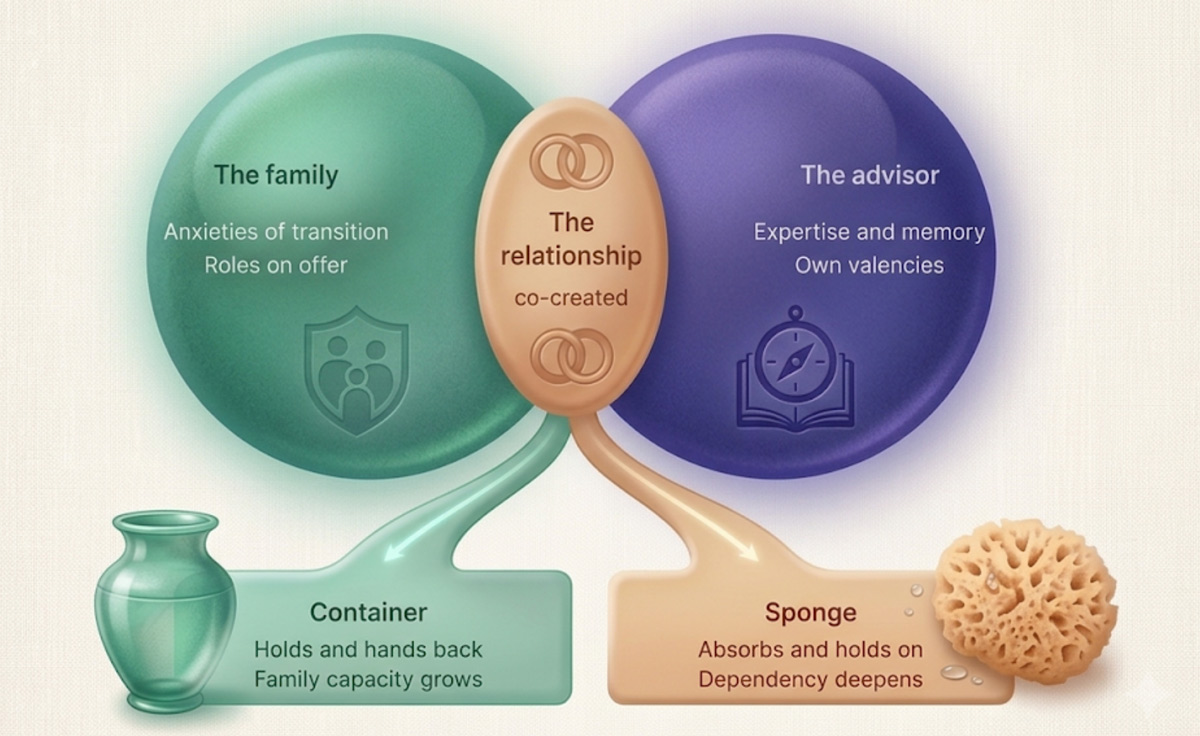
A sponge absorbs the family’s anxieties, keeps its secrets, and takes over decisions that belong to the owners. This brings temporary relief to the system, but the family’s capacity does not grow. A container provides defined boundaries within which the family must do the work. The advisor takes in the tensions, processes them, and hands them back to the family in a form they can deal with. The family’s capacity strengthens.
Dependency as a Co-Created State
When a family business faces the anxiety of intergenerational transition, structural misalignment, or relational tensions, it naturally seeks to defend a comfortable status quo. Long-term advisors may then be drawn deeper into the family system, not only to provide technical expertise but also to buffer the discomfort of confrontation and change. Retaining the advisor year after year creates a reassuring sense of progress. The family can tell itself, “We are actively working on our governance,” while deferring the harder work of building capacity, transferring authority, or resolving conflicts.
Meanwhile, slow progress reinforces the belief that the work remains unfinished, and the advisor becomes further embedded. The signs are familiar: quarterly meetings that continue without resolution, a governance project perpetually nearing completion, or a family constitution that always needs one more revision. The engagement continues because what happens after completion has become too hard for both the family and the advisor to imagine.

It Is Good to Be Needed
Hank recalls the time the chairman decided the business was expanding too fast. It was Hank he approached to carry the message to John: “He is the CEO now. I would rather it not come from me.” Hank waited for the next strategy review to suggest that John consider a more measured pace of growth.
And there was the time Jenny felt her compensation no longer matched her contribution. She sought Hank’s help in proposing an executive compensation benchmarking exercise at the next board meeting.
Hank felt that his influence reflected his standing as the family’s most trusted advisor—something that was hard won.
Many advisors naturally take pride in being seen as the wise counselor to a family, the ultimate confirmation of value and trust.
The family system, for its part, has roles on offer. It pulls an advisor into positions unfilled within the family: messenger, mediator, arbiter, or even surrogate parent. The pull is strongest during periods of relational tension, when the advisor may be triangulated into absorbing the emotional intensity (Bowen 1978). It is the meeting of the family’s needs and the advisor’s own valencies (Bion 1961) that makes the dynamic comfortable and enduring.
Neither side creates it alone, and neither may notice it forming. When the advisor derives reassurance from being the only person able to pacify a patriarch or translate between warring siblings, the work has shifted from building the family’s capacity to sustaining the advisor’s place within the system, potentially marking the beginning of an unhealthy spongelike entanglement.
Information Vault or Bridge
Over time, an advisor may become the sole repository for the family’s unwritten history, generational confidences, and unspoken promises. While this institutional memory reflects deep trust, maintaining informational asymmetry creates dependency rather than connection.
The advisor’s job is not to be the vault but the bridge, guiding information through the appropriate family, ownership, or business forums.
The Questions That Reveal the Dependency
It can be hard to see the distinction between being trusted and being entangled from the inside. The table below helps to evaluate an engagement across five domains from three different perspectives.
The value of these questions is not that they produce any correct answers, but that a family and an advisor who can discuss them openly have already demonstrated the kind of relationship that resists dependency.
Five Domains for Evaluating an Engagement
The Advisor as Container
Regardless of experience or the stage of an engagement, there may come a moment when an advisor becomes aware of the paradox: being emotionally drawn into the family’s unspoken dynamics or confusing feeling needed with real client value.
Such moments can serve as diagnostic points that an advisor can use to affirm the true value they are delivering:
Whose task is this?
What role am I being drawn into?
As for Hank, the question he must ask himself is not what the chairman is about to announce. Rather, it is why both children turned toward him, again.
References
Bion, W. R. 1970. Attention and Interpretation. Tavistock Publications.
Bowen, M. 1978. Family Therapy in Clinical Practice. Jason Aronson.
Kets de Vries, M. F. R. 2011. The Leader on the Couch: A Clinical Approach to Psychodynamic Leadership. John Wiley & Sons.